

How to Understand Contemporary Abstract Art: A Clear Guide
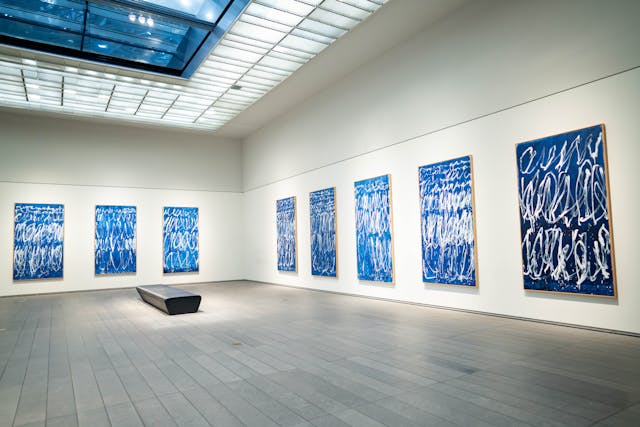
The question of how to understand contemporary abstract art often arises the minute one walks into a modern gallery and discovers nothing on the wall looks familiar. It can initially be confusing to understand contemporary abstract art because there are no obvious subjects, no clear narratives, and often no immediate “meaning” to latch onto.
Of pictures of landscapes, portraits or scenes you see blocks of colour, brushstrokes shapes all over the place or simple quiet designs. Many people react the way: they look at it and think “What am I supposed to see here?” They expect something like a photo or a drawing of a real place or person. But this art is different it is more about colours and shapes. It makes you think and feel something. Not, in a usual way.
The surprising fact is, modern abstract art isn’t meant to be “solved.” It is something to be experienced. Once you grasp this shift, the entire viewing experience becomes more intuitive, personal and even fun.
This guide is about how to understand contemporary abstract art in a practical, human and usable way, whether you’re visiting a museum, browsing online galleries or just hoping to gain some confidence around modern art.
What Contemporary Abstract Art Really Is

To understand contemporary abstract art, you first have to learn what “abstract” actually means in a modern context.
Contemporary abstract art eliminates traditional representation and replaces it with:
- Emotion rather than story
- Color instead of objects.
- Rather storyline, composition
- Movement rather than realism
The artists who worked with Abstract Expressionism made this change happen. They wanted the brushwork to be spontaneous and the artwork to be emotionally expressive than just showing things exactly as they are.
Nowadays modern abstract artists are still changing things. They are combining painting, with digital media, installation work and experimental techniques to create something new. Abstract Expressionism is still influencing the abstract artists as they continue to evolve.
Take the legacy of artists like Mark Rothko. His large fields of colour do not try to picture objects, but emotional states – grief, calm, transcendence.
So, when learning how to understand contemporary abstract art, it is not identification that is the goal; it is interpretation through perception.
Why Abstract Art Looks Confusing at First
Much of the how to understand contemporary abstract art is to understand why it feels alien.
Most people are trained from childhood to take visual information at face value.
- tree = drawing of a tree
- Painting of a face = Person
- A landscape is a place
Abstract art does away with that expectation altogether.
Instead, it communicates via:
- Color relations
- Tension in space
- Variation in texture
- Energy in brushstroke
This can be a disorienting shift because your brain will continue to ask for “what it is” but the real question is “what it feels like.”
This is why museums such as the Museum of Modern Art (MoMA) tend to guide the visitor toward emotional interpretation rather than literal understanding.
how to understand contemporary abstract art becomes much easier if you can accept ambiguity as part of the experience.
The Visual Language of Abstract Painting
To get to the bottom of contemporary abstract art, you have to learn a whole new visual language.
Take music, for example. You don’t ‘translate’ sound into meaning, you experience it.

The main visual elements are:
1. Hue
- Warm colors (reds, oranges) are often perceived as energetic or emotional.
- Cool colors (blues, greens) look calm or distant
- High contrast creates tension.
2. Form
- Conflict or intensity means sharp angles.
- Peaceful organic rounded forms,
3. Tactile sensation
- Physical energy of impasto (thick paint)
- Slick surfaces feel controlled, meditative
4. Composition
- Dense areas can seem chaotic or overwhelming
- Open space provides calm or isolation
Artists such as Jackson Pollock employed rhythm and dripping paint to make the canvas a record of physical motion .
Understanding this visual language is central to how to understand contemporary abstract art , for meaning comes from interaction—not translation.
How to Understand Abstract Art Step by Step
Here is a practical way of how to understand contemporary abstract art in real time.
Step 1: Observe without making judgments
Let yourself just observe for 30 to 60 seconds.
Step 2. Recognize the dominant elements
Question:
- What colors pop?
- What is the visual weight?
- Is the piece harmonious or not harmonious?
Step 3: Follow the Move
Let your eyes follow the natural path over the canvas.
Step 4: Note the emotional response
Is there tension, calm, discomfort, curiosity, energy?
Step 5: Make a personal interpretation
Not a “right answer” but your interpretation of the work.
This process is very common in contemporary museum education and is essential for the how to understand contemporary abstract art in a meaningful way.
Common Misconceptions Beginners Make

To gain a better appreciation for how to understand contemporary abstract art, some myths need to be debunked.
Myth 1: There has to be an occult object.
Not always correct. Many works are simply expressive.
Myth 2: You need to know art history
Helpful but not obligatory for emotional interpretation.
Myth 3: Confusion means you don’t “get it”
Confusion is often the beginning, not a failure.
Myth 4: There is one meaning to each piece
Most contemporary abstract art is deliberately open-ended.
Institutions like the Tate Modern are actively encouraging multiple interpretations, reinforcing the fluidity of meaning.
Advanced Methods for Further Analysis
Professionals apply layered approaches when practicing on how to understand contemporary abstract art.
1. Analyse formelle
Deconstruct structure, composition and technique.
2. Emotional cartography
Feel how different parts of the work make you feel.
3. Study in the context
Get to know the artist’s background, inspirations and intentions.
4. Watching alongside
Look at several works by the same artist to find patterns.
5. The practice of slow looking
Take your time. Work on one piece for a long time.
These techniques make the understanding of contemporary abstract art into a skill, not guesswork.
How to Develop Your Own Interpreting Skills
One of the best ways to improve understanding of contemporary abstract art is repetition.
Why not try this weekly habit:
- Visit a gallery or an online collection
- Spend 5-10 minutes on each artwork
- Record initial impressions before research
- Then compare your thoughts with artist statements
You will see as time passes:
- Better emotional detection
- Rapid detection of visual patterns
- Increased comfort with ambiguity
That’s where abstract art goes from feeling “difficult” to feeling natural.
Why Abstract Art is Really Emotionally Appealing
One of the big insights of how to understand contemporary abstract art is that often meaning bypasses logic altogether.
Abstract art works because it:
- Appeals directly to emotion
- Removes language barriers
- Reflects internal psychic states
- Allows for personal interpretation.
That’s why two people can look at the same painting and have totally different reactions—and both can be right.
Summary
Contemporary abstract art is not about deciphering symbols or looking for a hidden message. It’s about learning to look, feel and read visual language without needing to be sure.
Abstract art becomes a lot more approachable and immensely satisfying when you move from asking yourself “What does this mean?” to “What do I experience?”
how to understand contemporary abstract art is less a matter of knowledge than of attention, curiosity and openness in the long run.

